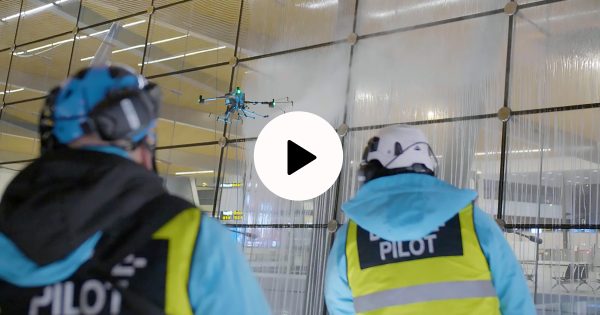
This week KTV Working Drone carried out window cleaning at Bergen Airport in Norway. The location represents one of the most demanding environments for this type of cleaning operation.
The operation had to be completed within a three hour night window, during which 2,500 m² of glass façade had to be cleaned.
The site presents challenging operating conditions. The terminal area acts as a wind tunnel, while the metal roof structure significantly limits GPS signals. In addition, signal interference and complex RF environments make drone operations technically demanding in this type of infrastructure.
To handle these conditions, the operation was performed using the new DJI M400 platform integrated with sensors and software developed by KTV Working Drone. The mission was completed with high precision and without technical issues.
This capability is the result of continued collaboration between KTV and DJI, focusing on solving operational challenges in complex environments such as airports, industrial facilities and other locations with demanding signal conditions.
The glass surfaces at Bergen Airport also represent a significant cleaning challenge. The level of contamination is very high, and previous manual cleaning operations using rope access teams have taken several weeks without achieving the desired level of cleanliness.
Through continuous development of new cleaning methods, KTV Working Drone has developed techniques capable of handling extreme contamination conditions. For this project, the new KTV Window Facade+ chemistry was used with very good results.
An important milestone is that even heavily contaminated windows, which previously could not be cleaned effectively using drone technology, can now be restored with very good results.
Another important advantage is that the system does not involve mechanical contact with the glass during cleaning. This eliminates the risk of scratches and surface damage, which can often occur with traditional manual cleaning methods.
Conclusion.
The experience from this project confirms that the technology is now mature enough to operate in some of the most demanding environments and cleaning operations within this type of work.
When comparing where the technology stood in 2020 with the first generation systems to where it is today in 2026, the difference is significant.